Jana Sopf
Culpeper (1996) defines impoliteness as politeness’ ‘parasite’—a tad drastic, is it not? However, envisaging impoliteness as a parasitic entity can possibly account for the strange relationship between politeness and impoliteness. If we think of impoliteness as politeness’ evil twin sibling, it explains the root difference between the two: one aims to sustain peace and one to attack the interlocutor. However, this model does not necessarily account for behaviour that is not inherently polite nor impolite, which is entirely context-dependent and socially governed. This brings us back full circle: politeness as a phenomenon is somewhat universal across cultures (in the sense that as humans we try to be as decent as possible, or should strive to, anyway), but this is relative to which culture setting you find yourself in. This brings us to yet another indefinite claim, because there is no all-encompassing way to define and account for the notion of culture itself. When we speak of intercultural or cross-cultural interactions, how can we precisely define which cultural framework you are drawing from as a speaker of a foreign language for example? Where does culture end and identity begin? To draw the chicken and egg debate to a close, let us mull over the fact that we must approach the idea of politeness across cultures with respect, openness and understanding first and foremost, and an awareness that misalignments of expectations are bound to occur, sooner or later.
Five superstrategies of impoliteness (Culpeper 1996)
| Superstrategy | Description | Example |
| Bald on-record impoliteness | “The FTA is performed in a direct, clear, unambiguous and concise way in circumstances where face is not irrelevant or minimised” (1996, p. 356). | You’re ugly! Shut up! |
| Positive impoliteness | “The use of strategies designed to damage the addressee’s positive face wants” (1996, p. 356). | Criticising someone (e.g. You’re such an embarrassment!), excluding or ignoring |
| Negative impoliteness | “The use of strategies designed to damage the addressee’s negative face wants” (1996, p. 356). | Threatening, or invading someone’s privacy/space (i.e. imposing oneself) |
| Sarcasm or mock politeness | “The FTA is performed with the use of politeness strategies that are obviously insincere, and thus remain surface realisations” (1996, p. 356). | No offense but you’re a twat. The value of no offence as an inherent politeness strategy is cancelled by the following text. Sarcasm on the other hand is usually indicated by intonation. |
| Withhold politeness | “The absence of politeness work where is should be expected” (1996, p. 357). | Failing to say thank you upon receiving something from someone (a cultural norm in most Western countries). |
Culpeper (1996) outlines five ‘superstragies’ of impoliteness that are “opposed in terms of orientation to face,” with the goal of reversing Brown & Levinson’s (1987) model to the needs of impoliteness (p. 356). Given the sheer amount of theories and frameworks that each find yet another problem with claiming universality of politeness or impoliteness, how can we best define impoliteness? Bousfield and Locher (2008) offer a mathematical solution: the “lowest common denominator” of impoliteness is “a behaviour that is face-aggravating in a particular context” (p. 3). While this conceptualization is schematic and easy to grasp, one may also argue that it ignores the nuances of impoliteness. However, we may never be able to be satisfied with a definition by that logic.
“Impoliteness is a negative attitude towards specific behaviours occurring in specific contexts. It is sustained by expectations, desires and/or beliefs about social organisation, including, in particular, how one person’s or group’s identities are mediated by others in interaction”
(Culpeper 2011, p. 23).
To muddle the waters a little bit more, Leech (2014) introduces the notion of nonpoliteness (Leech 2014, p. 216) as being a lack of politeness. Now, where exactly does it stand on the spectrum of (im)politeness?
Impoliteness and humour – is conveying humour through impoliteness amusing or plain rude?
Although it may seem rude, impoliteness does not have to be avoided like the plague. In fact, researchers claim that the entire field of linguistic impoliteness was “overshadowed” by its angelic counterpart (Bousfield & Locher 2008, p. 2). In fact, impoliteness is used as a humorous phenomenon in many television series. Most distinct; however, is the use of sarcasm as the key trait of many iconic characters – think Sherlock (Sherlock), Chandler Bing (Friends) and Dr. House (House M.D.). How and why is verbal impoliteness used to evoke a giggle from the audience? And just what kind of impoliteness is humorous?
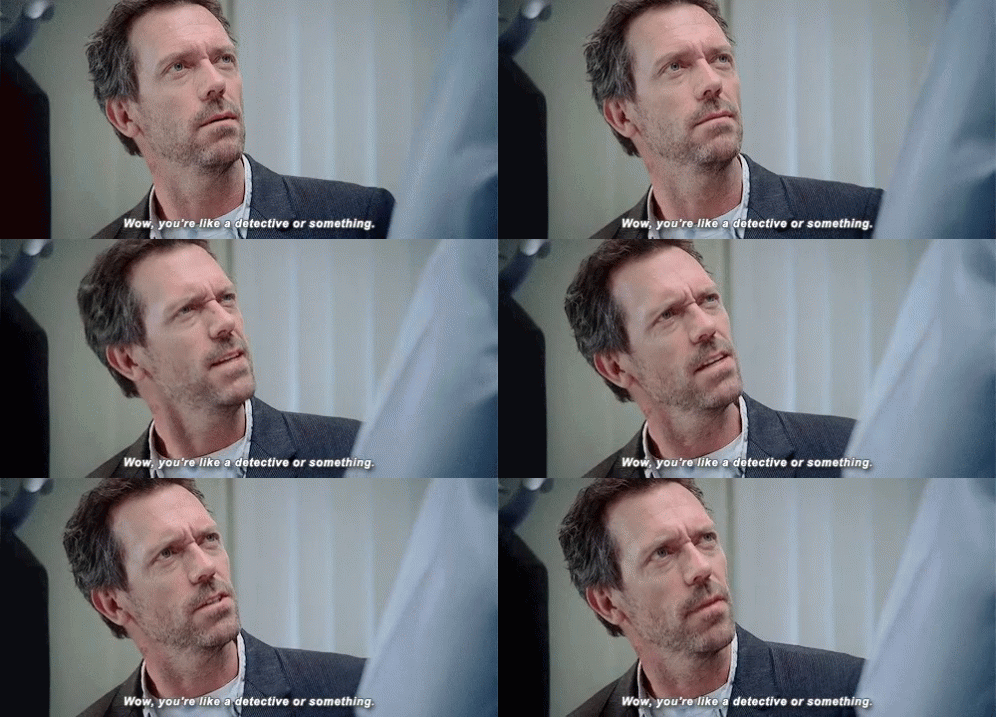
The acclaimed BBC’s Sherlock has provided researchers with plenty of data to study impoliteness strategies. Although Arthur Conan’s character has been adapted on numerous occasions, the core essence of the detective we all know and love—his mildly difficult character—has remained fairly constant. But the biggest mystery of all might be that of the rude detective: what is so amusing about a witty detective who regularly crutches on impolite linguistic behaviour to convey humour? Sarcasm is described as both a type of humour and a type of implicational impoliteness – a perfect combination of the two. What exactly makes it humorous? After all, not all impolite and borderline rude behaviour can be downplayed as part of a punchline. Perhaps sarcasm, if executed well, is guaranteed to bring about a smirk or laugh simply as an admiration of structural creativity. Its inherent impoliteness is somewhat two-fold; if you get the joke, good for you and your deductive skills! However, if you do not, no harm done – you missed out on the joke, but also the element of impoliteness. It would be interesting to know how such nuances of sarcasm in television series are translated. As most things, humour is context and culturally dependent and most likely to be lost in translation.
For a little practical information, here is what Culpeper (2003) suggests are the three main choices to respond to a face-threatening or act of impoliteness: you can opt to accept the face attack (i.e. plead guilty), counter the face attack (either offensively or defensively) or you can choose to be the bigger person and not respond at all. It comes as little surprise that the response strategies employ wartime metaphors.
 Intercultural Politeness