Rationale

Rationale

Welcome to the politeness blog!

Group
Our blog posts have all been tailored to be read as a single piece, not as individual pieces. Hence, there is an attempt to define key terms necessary for understanding the field of intercultural pragmatics as well as politeness. 

Although all the content was written with a public audience in mind, but the blog will be kept private to avoid any potential copyright issues with the embedded assortment of images, memes and videos.

Mikayla Marriott-Smith

For my blog posts I have been focusing on both negative and positive politeness strategies. I opted to take a ‘guide’ style to writing these, using the second person plural ‘you’. I decided to write these from this angle to show that politeness strategies can be performed based on what the speaker wishes to achieve from the conversation. 

I also broke down both positive and negative politeness strategies into three parts. Putting information into sections is a common feature of blog posts as it makes the information easier to understand for the reader. 

In the final part of each blog post I included examples positive and negative politeness from other cultures. 

Jana Sopf

My posts centred around politeness in professional settings (focusing on e-mails) and intercultural (im)politeness (focusing on humour and sarcasm) as a way of narrowing down the topic and segmenting the information into understandable sections. I discuss negotiating politeness in professional settings and the main research findings in this field. The second blog post discusses theories of impoliteness and how it is positioned in relation to broad politeness theories and frameworks. I also discuss humorous impoliteness, specifically sarcasm through the lens of television’s iconic characters. I decided to focus on something that the intended audience is familiar with as a way of introducing the subject without going into too much depth, but also trying to relate back to important theoretical concepts. After reviewing academic sources, I attempted to condense and simplify the key elements of research and present it in a simplified and engaging way, using informative tables to complement funny Tweets.

Niamh Powell

The blog posts I worked on were surrounding manners and politeness, as well as Pragmatic theories of politeness, with its history. I took a personal outlook on parts of these blog posts as to illustrate it is a phenomenon that affects not only the audience but also me as the writer. I spoke about personal feelings such as being ‘naïve’ and ‘taking English for granted’, as I think these are aspects of the British culture this module has highlighted for me.

In my blog post on the theories of pragmatic politeness, I took a brief outlook on some theorists. Arguably the theories I chose to use in the article were the theories that stood out the strongest to me as the author. Ones that I believed to be fundamental to understanding politeness, but also that I found the most interesting to read. I did not go into too much detail discussing the theories as the brief of this assignment suggested to write to an audience with no real knowledge of linguistic theory. In order to not overload the reader, I kept it simple with the commentary. Most of my blog posts focus on using examples within other cultures as I believed this to be an intrinsic part of the module.

Emma Coles

For my blog posts I have focused on an overview of politeness theory and intercultural politeness, as opposed to cross cultural politeness. I have aimed the posts at readers who may be unfamiliar with politeness, attempting to explain how politeness manifests itself in a variety of ways, detailing the theories on these. I have tried to use examples to communicate how politeness differs in different contexts, with a particular focus on intercultural politeness and how theories and strategies are used in communication between participants from distinct cultures. 

For my first post,I have focused on giving a general overview of what the theory of politeness entails. I have used examples from a Brown & Levinson perspective and have tried to put these ideas in a more accessible form, for people who are not familiar with the theory and its terms. 

For my second post, I have focused specifically on politeness in intercultural communications. Using examples from Holmes, I have detailed how and why politeness is not a universal theory. I have tried to explain why intercultural politeness differs from cross cultural, using examples and information from Spencer-Oatey to do so.  

Victor Tang

My blog attempts engage the readers who do not have the academic knowledge on face and apology in a brief internet journey from an intercultural perspective. 

For my first post, I started it with a scenario simulation which helps to explain what “face” is and note that which choice is actually doing face-threatening act (FTA) or saving the face. Also, from the intercultural aspect, I made a quick explain on the complexity of definition of “face” and gave my personal understanding. Then I extended the FTA to illustrate positive face and negative face. Finally, I went back to the scenario simulation for my argument that in different cultural context, different strategies or choice have the priority. 

In my second post, I started with five main types of apology strategies. Then I argued that the language people speaker may impact the choice of apology strategies and gave some examples to support it. Moreover, I presented other aspects that may affect the choice. Finally, as a personal blog, I gave some personal understanding on apology. 
What is Politeness Theory?

What is Politeness Theory?

Emma Coles

As kids we were always told “treat others how you wish to be treated” and this is something we learn as adults too, just in ways that work in different situations and scenarios.

To be polite in interactions, we have to want to be polite and have a genuine desire to be pleasant to one another. Whilst our body language, smiles and stance may show someone we’re interested in what they have to say, to really show just how pleasant we may be, we have to use specific language to do so.

Even though using our ‘please’ and ‘thankyous’ are indeed polite, this is something we would usually expect when requesting or receiving a gift, for example, so to be polite in conversations rather than transactions, we often need to go beyond just using our manners.

We should always be aware of just who we are speaking to, relationships change everything! Whilst you might ask your close friend what their age or weight is, you wouldn’t ask something so personal to someone you just met or someone you have a professional rather than friendly relationship with. This goes for compliments too, whilst you might think someone wants to hear your opinion or comment, you never know what position you could put someone in with it, so you should always assess the situation and the relationship first. Calling your bestie a stunner might be ok but addressing a stranger isn’t always the brightest of ideas!

Brown & Levinson discuss that whilst we often think that to be polite we should be positive, we can be negative if we want to. To be positive is to see a silver lining, to big yourself up or sometimes to even soften the blow. Whilst we have opinions, so do others, so to be positive is to listen and appreciate what others have to say or contribute, perhaps add a little of your own material to it or simply just be sympathetic and try to understand what the other person has to say. Sometimes we struggle to have anything positive to say, so negativity takes control. Negativity doesn’t always have to be directed towards others, but it can be about ourselves too. Whether it’s softening a statement or simply dismissing it, negativity comes in various forms. Often negativity is misinterpreted as pessimistic and rude behaviour, but in politeness theory negative politeness attempts to avoid imposition on speakers.

Politeness manifests itself in various ways, through language and through face. Another way we can show we are polite is through involving others. Scollon & Scollon (1995) talk about involvement and independence strategies, reflecting the general human social needs to be connected to other people, yet also to be independent and unique.

To involve others in conversation we could use a variety of strategies:

  • Paying attention to the other person, or taking care of them. You can do this through saying “You have a beautiful dress” or asking them ” Are you feeling any better?”
  • Being optimistic! Saying ” I know we can do this” or ” I believe in us”
  • Being voluble, simply speaking up. Just speaking in an interaction shows you’re willing to get involvedd.
  • Using other languages. If you’ve got it, why not flaunt it in conversation? That shows you’re willing to make an effort with others, as well as encouraging them to get involved regardless of the language being used.

Just like we can be negative, we can be independent in conversation too. There are a few different ways we do this, some more polite than others.

  • Giving the other person a chance to retreat, for example, “It would have been nice to go out at the weekend but you must have other plans”
  • Speaking in general terms rather than personally. “The rules say this…”
  • Not speaking much! Sometimes actions do speak louder than words.
  • Using your own language or dialect. Whilst sometimes this Is the only resort, In environments where you could use another language, choosing not to use one could appear as a lack of willingness to get involved and make an effort.

It is important to remember that whilst we were always taught to treat others in the ways we would like to be treated, not everybody feels the same and we can never know how others would like to be treated until we build that relationship with them.

Pragmatic Theory and History of Politeness

Pragmatic Theory and History of Politeness

The Past and Present of Politeness

Niamh Powell

Since before I can remember the words please and thank you have been an unconscious part of my vocabulary. Engrained in my vocabulary by my mother, but now the question arises in my head. How long has politeness been around for?

Politeness is an old and grey concept in most languages. The words themselves in different languages have specific historical connotations. In German for example the term Höflichkeit, refers to hof (‘court’) (Watts et al, 2019). In French the word poli is the past participle of polir ‘to polish’ (Watts, 2003).
In most historical counts of politeness, the court becomes the main reference as to where politeness develops. Even go so far as to say the court became a tool that of structured a social hierarchy in both France and Germany. Interesting right?
However, its history in English is slightly more complex. We don’t have any connotations which ties into the understanding of the word politeness.

Yet, the phenomenon of politeness is something that through the scientific study of language has become a widely known topic in the English history. Heavily within the history of scientific language study is the development of theories surrounding the phenomenon. Something which is still used today when discussing politeness. Here are some theories you need to know;

Theories of politeness you want to know about.

Robin Lakoff (1973)

“The mother of modern politeness theory”

Eelen (1999)

Lakoff kick-started the thought processes of looking at politeness, but it is important to know that his theory doesn’t give answers to all aspects of politeness. He states 3 important rules in his theory.

3 politeness rules

  1. Don’t impose
  2. Give options
  3. Make a feel good – be friendly

Brown and Levinson (1987)/ (1978)

The whole bases of their theory rely upon FTA – face threatening acts. For more information on this read our blog post.
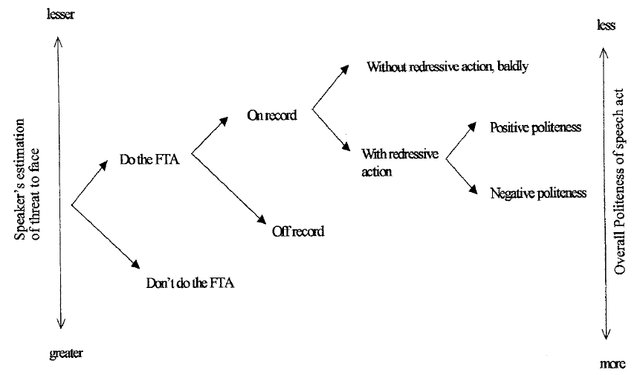
Brown and Levinson argue we have five major strategies into performing politeness. Here is their diagram;

Spencer-Oatey (2000b)

Develops her theory of politeness using some of the ideas surrounding face, but in the more general topic of rapport management. The two most important aspects of her theory centres upon the management of face and management of sociality rights. She puts a large amount of importance on sociality and face. Sociality can be described as what the social norms or tendencies individuals in communities have. Spencer-Oatey discusses in her theory the importance of this when performing politeness.

Face

Face

Victor

Before we start today’s journey, let me show you a scenario simulation to do!

It is really hot in summer (even in the UK, during some weeks, it will be like a furnace outside), isn’t it? You are chilling at one of your friends’. After a while, you feel very thirsty and you would like some beer (and, of course, you are assumed over 18!). Regardless of your affinity for your friends, what below are you most likely to say if you would like to grab the beer from your friend’s fridge?

A. I want some beer.

B. Is it okay for me to have a beer, mate?

C. I hope it’s not too forward, but would it be possible for me to have a beer?

D. It’s so hot. It makes you really thirsty.

E. No, I would just bear with the thirst rather than ask for beer.

Now that you (my readers) have various cultural backgrounds, I’m sure your choices will be different. Thanks to Brown and Levinson (B&L) (1987), they category options B to D as politeness strategies for face-threatening acts (FTA). That means, if you stand for any of those 3 choices, you may be trying to save your friend’s face on that occasion. In contrast, A is challenging your friend’s face unless you have very close relationships.

It seems that A causing the “threatening” result while B, C and D trying to “save”, they are doing such a big work. Well, just wait take it easy, let me explain what face is.

“Face” was first introduced by Goffman (1955:213) as “the positive social value a person effectively claims for himself by the line others assume he has taken during a personal contact”. Brown & Levinson (1987:61) reformulated it as “the public self-image that every member wants to claim for himself”. The definitions sound way too abstract and “academic”. The definition of face is not written in stone but in different cultures, it may include nuanced differences.

In Chinese discourse , “face” understood as 面子, which refers to one’s social status and prestige (Wang, 2019:341). For example, when some conflicts occur between two people in China, the mediator would say “看在我的面子上“(for my face), where face is more likely to be defined as “sake” like “for god’s sake”. Namely, the mediator is using their prestige to ask both sides to forgive each other. In my understanding, face is a desire that people would maintain to indicate their social image or status when they interact with others. Furthermore, Brown & Levinson (1987) distinguish between two dimensions of face:

Positive Face: The desire to be appreciated and approved of;

Negative Face: The desire to be autonomous or unimpeded.

Accordingly, criticising, disagreeing, insulting, complaining, insincere offers and promised are threatening positive face, like when your teacher criticises you for not bringing your homework to class. Commanding, inviting, requesting, suggesting, warning and personal questions are threatening negative face, like when you are about to go to your high school prom and your mom warns that the curfews still apply to you.

Therefore from the examples A-E above, it is easy to find out that A, as a direct request, is threatening your friend’s negative face. B, as positive politeness that protects the interlocutor’s positive face, starts with the question that includes both the speaker and the hearer in activity (you have the right to decide if I can have a beer). C, as negative politeness that protects the interlocutor’s negative face, the euphemistic tone of the speaker claims autonomy (of beer) belongs to the hearer; D is an off-record strategies that uses the hint to request the beer to hearer indirectly.

So, how do you like your choice of saving (or destroying) your friend’s face? Do you think your choice is the best strategy of them? Well, I would not say which one is the best, but rather say your choice is the best in your cultural context. B is seemingly a traditional British request, isn’t it, my mate? The wording “mate” enhances solidarity between you and me and it sounds cool in contrast with our expression (unless you are a supporter of E and would bear the thirst). But not everyone thinks like a British.

Collective cultures such as Japanese, Arabic, Chinese would have a preference on D as in their cultures, indirect speech acts are perceived as the priority in politeness. For example, in English, “Would you pass the salt to me?” is a polite request with the subjunctive mood but in Japanese, they would give hints like “Is that salt?” to avoid any possibility of being rejected (If the hearer doesn’t want to pass the salt to the speaker, he would possibly pretend no to get the hint; the speaker could also claim that he doesn’t mean to make the request). In other words, Japanese conventional indirect forms are not equivalent to those of English (Matsumoto, 1988:421).

Different options of politeness strategies according to different cultures may result in being less effectively in FTA or even negative comprehension from the hearer. C as a politeness strategy to respect the autonomy of the individual, in Polish cultures, However, it is perceived as hostility and alienation once such a distance is established (Mills, 2017:35). 

Finally, even though good manners are the art of making it easy for us to converse with people, too much politeness sounds unnatural and may even result in misunderstanding of politeness. Politeness is troubling for intercultural communication but it won’t be much annoying as long as you find out. Trust me you can make it! 

Apologies

Apologies

Victor

Are you concerned about how to apologise to someone? Is it always too late to say sorry like Justin Bieber told you? Come with me, perhaps you may pick up some communicative skills on apology from the intercultural aspect.

First of all, you should be aware of five main types of apology strategies that Olshtain and Cohen (1983) classified. They are: explanation, expression of apology, promise of non-recurrence, acknowledgement of responsibility, and offer of repair.

A. Explanation, literally, is to make excuses or account, that is help to transferred offenders fault like in “The bus was late”.

B. Expression of apology, is just to say “sorry,” “excuse,” “forgive,” or “apologise.”

C. Promise of non-recurrence means the offense is promised not to happen again. Typically, you can find this strategy from cheating husbands who are trying to their marriage.

D. Acknowledgement of responsibility means the offender recognises his fault in causing the infraction. Simply, to shout “I did it. It was my fault”.

E. Offer of repair is to offer compensation as a means to apologise. For example, many merchants will sorry with a voucher despite of consideration on their business strategies.

In terms of various linguistic realisation patterns amongst different languages, the productions and perceptions of apologies vary (Wang, 2017:40). In other words, language, as an aspect of culture, influences language speakers’ strategic preferences and evaluative opinions on apology. Sari’s research (2016) discussed American English native speakers’ apology strategies and she found out that the most effective strategies are to offer repairs and take on responsibility whilst promise of forbearance seems not to be working amongst them.

In contrast, Japanese apologisers attach more importance on expression of regret and their own responsibility, however, refusal offer fair compensation (Lingley, 2006). Naotsuka and Sakamoto (1981:166-167) explain that, apology is one of honorific forms in Japanese systems, aiming beyond the speech acts itself to keep things running smoothly for both the hearer and speaker (eg. defusing an awkward situation by apology). Interestingly, even though the strategy of warranting repair works effectively for American, when their role turns an apologiser, they tend not to offer nothing to maintain their autonomy (i.e. like mentioned in the blog on ‘Face’, to maintain their negative face).

Apart from language, also, the context, the degree of familiarity, level of the offence and other factors require the speaker to make different and complex utterances for apology. For instance, females takes explicit and indirect apology strategies used more frequently than males (Wang:2017); instead of offering repairs reluctantly, superiors’ simply but sincere apology is more acceptable by the subordinates (Al-Adaileh, 2007); from the perspective of Chinese-Australian, frequent apology in daily conversation is considered to be impolite (Chang and Haugh, 2011).

Dealing with apology strategies is actually handling cultural differences. Is it too late to say sorry? Well, I would say in some cultures or context, a sincere or appropriate apology can make it up. I know this suggestion sounds tricky but what I really want to say is that apology is not a facile work and there’s no such formulaic strategies that cover all the situations. What’s more, not every offense is able to be forgiven. But as long as you are attempting to formulate intercultural competence, no matter it’s for politeness or offense, apology you give or receive is more likely to be understood and accepted.

Intercultural Politeness

Intercultural Politeness

Emma Coles

Intercultural Communication

Just like the video above shows how communication differs across cultures, so do the strategies used for politeness in intercultural interactions. Janet Holmes gives us this scenario to consider:

Tino, a young Samoan boy who had recently arrived in New Zealand, was summoned to the office of the school principal for being repeatedly late for school. He knocked on the door of the principal’s office. When he was told to come in, he walked in with hunched shoulders, scuttled over to a chair and sat down without being asked to do so by the principal. In response to the principal’s questions, he either said nothing or he muttered I don’t know.He looked down at the floor throughout the interview and never met the principal’s eyes.

Janet Holmes. Politeness in Intercultural Discourse and Communication.

This communicative behaviour from Tino could be seen as problematic by his principal, as their expectations of culturally appropriate norms differ. For Tino this is an appropriate response to being summoned into the principal’s office as it is a traditional Samoan expression of respect but to the New Zealander principal, Tino seemed evasive and showing a lack of respect with his hunched stance. Issues often arise in intercultural encounters such as in this example, as both Tino and the principal had their own set of interactional norms to follow which instinctively they apply. When it comes to being polite, we make judgments about others on how polite or impolite they may be but we forget to consider that norms and strategies for politeness differ inter-culturally.

Holmes makes the distinction between cross and intercultural communication, detailing that where cross-cultural communication is a comparitive look into the practices of distinct cultural groups, intercultural communication differs as this focuses on the interactions between two distinct cultural groups.

When talking about politeness, researchers generally agree that politeness is a contextual judgement, not everyone agrees to what is and isn’t polite.

“No sentence is inherently polite or impolite”

Spencer-Oatey, (2000)

Our understanding of politeness ranges across cultures, so intercultural politeness is an interesting topic to study. Spencer-Oatey and Xing (2003) analysed two business meetings which took place in Britain to welcome members of a Chinese delegation with whom they had a business relationship. The meetings were recorded and the participants were then interviewed to gain insight into their opinions and interpretations of the meetings.

Whilst the British hosts responded with satisfaction to both the meetings, the Chinese delegates were very frustrated and offended by the second.

In an example where the British hosts had to rush a second meeting due to time constraints, the British participants found this interaction to be perfectly adequate in the circumstances but the Chinese delegates found this to be offensive as they felt a lack of respect had been shown to them.

This is a key example of where politeness differs between cultures and in intercultural interactions. Intercultural politeness is all about keeping the peace and making sure everyone in the interaction feels respected and at ease. Whilst being polite may feel second nature, sometimes we have to rethink what it means to be polite.

Intercultural (Im)politeness

Intercultural (Im)politeness

Jana Sopf

Culpeper (1996) defines impoliteness as politeness’ ‘parasite’—a tad drastic, is it not? However, envisaging impoliteness as a parasitic entity can possibly account for the strange relationship between politeness and impoliteness. If we think of impoliteness as politeness’ evil twin sibling, it explains the root difference between the two: one aims to sustain peace and one to attack the interlocutor. However, this model does not necessarily account for behaviour that is not inherently polite nor impolite, which is entirely context-dependent and socially governed. This brings us back full circle: politeness as a phenomenon is somewhat universal across cultures (in the sense that as humans we try to be as decent as possible, or should strive to, anyway), but this is relative to which culture setting you find yourself in. This brings us to yet another indefinite claim, because there is no all-encompassing way to define and account for the notion of culture itself. When we speak of intercultural or cross-cultural interactions, how can we precisely define which cultural framework you are drawing from as a speaker of a foreign language for example? Where does culture end and identity begin? To draw the chicken and egg debate to a close, let us mull over the fact that we must approach the idea of politeness across cultures with respect, openness and understanding first and foremost, and an awareness that misalignments of expectations are bound to occur, sooner or later.

Five superstrategies of impoliteness (Culpeper 1996)

Superstrategy Description Example
Bald on-record impoliteness “The FTA is performed in a direct, clear, unambiguous and concise way in circumstances where face is not irrelevant or minimised” (1996, p. 356).
You’re ugly!
Shut up!
Positive impoliteness “The use of strategies designed to damage the addressee’s positive face wants” (1996, p. 356). Criticising someone (e.g. You’re such an embarrassment!), excluding or ignoring
Negative impoliteness “The use of strategies designed to damage the addressee’s negative face wants” (1996, p. 356). Threatening, or invading someone’s privacy/space (i.e. imposing oneself)
Sarcasm or mock politeness “The FTA is performed with the use of politeness strategies that are obviously insincere, and thus remain surface realisations” (1996, p. 356). No offense but you’re a twat. The value of no offence as an inherent politeness strategy is cancelled by the following text.
Sarcasm on the other hand is usually indicated by intonation.
Withhold politeness “The absence of politeness work where is should be expected” (1996, p. 357). Failing to say thank you upon receiving something from someone (a cultural norm in most Western countries).

Culpeper (1996) outlines five ‘superstragies’ of impoliteness that are “opposed in terms of orientation to face,” with the goal of reversing Brown & Levinson’s (1987) model to the needs of impoliteness (p. 356). Given the sheer amount of theories and frameworks that each find yet another problem with claiming universality of politeness or impoliteness, how can we best define impoliteness? Bousfield and Locher (2008) offer a mathematical solution: the “lowest common denominator” of impoliteness is “a behaviour that is face-aggravating in a particular context” (p. 3). While this conceptualization is schematic and easy to grasp, one may also argue that it ignores the nuances of impoliteness. However, we may never be able to be satisfied with a definition by that logic.

“Impoliteness is a negative attitude towards specific behaviours occurring in specific contexts. It is sustained by expectations, desires and/or beliefs about social organisation, including, in particular, how one person’s or group’s identities are mediated by others in interaction”

(Culpeper 2011, p. 23).

To muddle the waters a little bit more, Leech (2014) introduces the notion of nonpoliteness (Leech 2014, p. 216) as being a lack of politeness. Now, where exactly does it stand on the spectrum of (im)politeness?

Impoliteness and humour – is conveying humour through impoliteness amusing or plain rude?

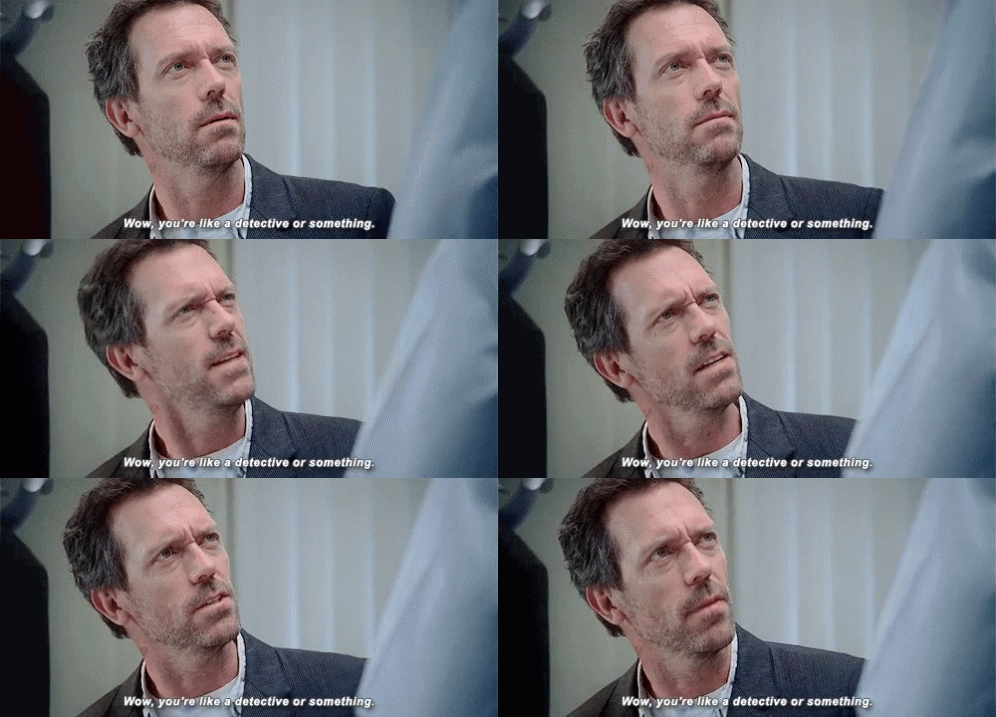
Although it may seem rude, impoliteness does not have to be avoided like the plague. In fact, researchers claim that the entire field of linguistic impoliteness was “overshadowed” by its angelic counterpart (Bousfield & Locher 2008, p. 2). In fact, impoliteness is used as a humorous phenomenon in many television series. Most distinct; however, is the use of sarcasm as the key trait of many iconic characters – think Sherlock (Sherlock), Chandler Bing (Friends) and Dr. House (House M.D.). How and why is verbal impoliteness used to evoke a giggle from the audience? And just what kind of impoliteness is humorous?

The acclaimed BBC’s Sherlock has provided researchers with plenty of data to study impoliteness strategies. Although Arthur Conan’s character has been adapted on numerous occasions, the core essence of the detective we all know and love—his mildly difficult character—has remained fairly constant. But the biggest mystery of all might be that of the rude detective: what is so amusing about a witty detective who regularly crutches on impolite linguistic behaviour to convey humour? Sarcasm is described as both a type of humour and a type of implicational impoliteness – a perfect combination of the two. What exactly makes it humorous? After all, not all impolite and borderline rude behaviour can be downplayed as part of a punchline. Perhaps sarcasm, if executed well, is guaranteed to bring about a smirk or laugh simply as an admiration of structural creativity. Its inherent impoliteness is somewhat two-fold; if you get the joke, good for you and your deductive skills! However, if you do not, no harm done – you missed out on the joke, but also the element of impoliteness. It would be interesting to know how such nuances of sarcasm in television series are translated. As most things, humour is context and culturally dependent and most likely to be lost in translation.

For a little practical information, here is what Culpeper (2003) suggests are the three main choices to respond to a face-threatening or act of impoliteness: you can opt to accept the face attack (i.e. plead guilty), counter the face attack (either offensively or defensively) or you can choose to be the bigger person and not respond at all. It comes as little surprise that the response strategies employ wartime metaphors.

Positive Politeness

Positive Politeness

Mikayla Marriott-Smith

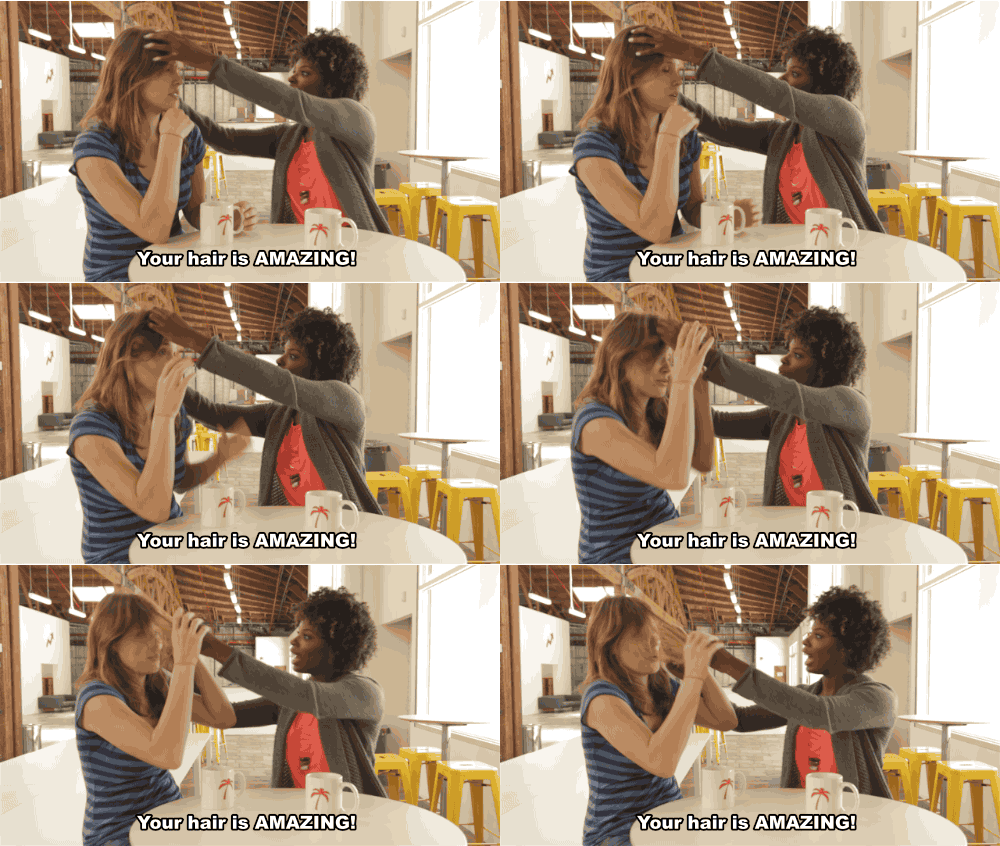
“Wow, I like your hair! Where did you get it cut?”

Positive politeness strategies. What are they? How do we do them? Are they universal? 

What are positive politeness strategies? 
You might choose to use positive politeness strategies to appeal to the listeners ‘positive face’ and expresses solidarity towards them. Positive face is “the want of every member that his wants to be desirable to at least some others” (Brown & Levinson, 1987:62). So, positive politeness strategies are great for when you want to get someone on your good side, or you want to be on their good side. You can usually do this by making them feel good about themselves or expressing an interest in them.

How do we do positive politeness strategies?
As Brown & Levinson (1987) did with negative politeness strategies, they also gave us a list of positive politeness strategies: 

  1. Notice, attend to the hearer (their interests, wants, needs, goods)
    Doing this strategy means you should be aware of how the listener is or if anything has changed with them
    What a beautiful vase this is! Where did it come from?
  2. Exaggerate (in interest, approval, and sympathy)
    “This is often done with exaggerated intonation, stress, and other aspects of prosodics (Brown & Levinson, 1987:104)
    How absolutely márvellous!
  3. Intensify interest to the listener 
    This means that you might make one of your stories even more interesting or dramatic
    I come downstairs, and what do you think I see? – a huge mess all over the place
  4. Use in-group identity markers
    Using these will form a bond with members in the group
    Mate, bud, love, babe 
  5. Seek agreement 
    Being able to agree with another member of the group will form a common ground and build a stronger relationship 
  6. Avoid disagreement 
    This means you may hide disagreement or avoid directly saying ‘no’ 
    a. Can you hear me? b. barely
  7. Presuppose/raise/assert common ground 
    You can find common ground by using small talk, gossip, or discussing interests 
  8. Joke
    “Since jokes are based on mutual shared background knowledge and values, jokes may be used to stress that shared background or those shared values” (Brown & Levinson, 1987: 124)
  9. Assert or presuppose speaker’s knowledge of and concern for hearers wants 
    This means to be aware of the hearer’s preferences and try to fit your wants around theirs 
    I know you can’t bear parties, but this one will really be good – do come! (request/offer)
  10. Offer, promise
    Making an offer or promise shows cooperation and willingness for the relationship even if the offer/promise is false
    I’ll drop by sometime next week
  11. Be optimistic
    This means to assume that the listener will cooperate with you
    Look, I’m sure you won’t mind if I borrow your typewriter
  12. Include both the speaker and hearer in the activity 
    You can do this easily by using the collective pronouns for instance ‘we’ ‘let’s’
    Let’s have a cookie, then. (i.e. me)

    (Brown and Levinson, 1987:103-128)

Are they universal?
As with negative politeness strategies, positive politeness strategies differ between cultures and are not universal as Brown and Levinson (1987) state. 

For instance, American English culture has a stronger preference to using the positive politeness strategies and building a relationship than British English culture does. Although, alternatively to American English culture, Chinese culture again use positive politeness differently.

In China, “politeness is through damaging the positive face of one’s own self” (Cheung, 2009:51). This can be done through people insulting something about themselves because “appearing humble will help maintain and enhance their face and image” (Chen, 1993: 55). This shows how you can use positive strategies to appeal to the positive face of the person you are speaking to or to save your own face.

That being said, speakers who are in communities which commonly use more positive politeness strategies may “come across as unsophisticated or vulgar if they find themselves in a community that is more orientated to negative face wants” (Meyerhoff, 2015:294). So, when you are going to use politeness strategies, be conscious of the cultural differences between yourself and the person you are speaking to as what they find polite can differ to what you find polite.

Negative Politeness

Negative Politeness

Mikayla Marriott-Smith

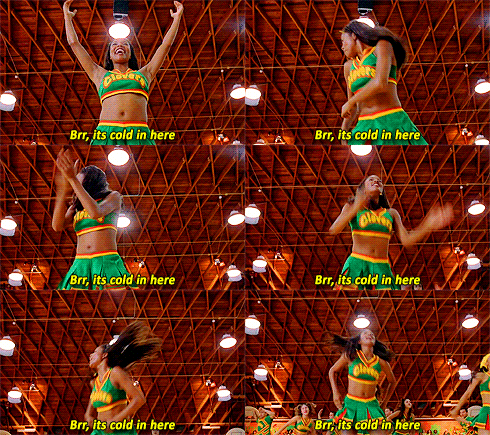
“It’s cold in here”

Negative politeness strategies. What are they? How do we do them? Are they universal? 


What are negative politeness strategies? 
Negative politeness strategies are used towards the listeners ‘negative face’. Someone’s negative face means “the want of every ‘competent adult member’ that his actions be unimpeded by others” (Brown & Levinson, 1987: 62). 

You would use negative politeness strategies when you do not want to impose on who you are speaking to. This means you would not want to bring any embarrassment or discomfort to them. So, this method is perfect for avoiding any awkward situations! 

How do we do negative politeness strategies? 

Brown and Levinson (1987) (the founding figures of negative and positive politeness strategies) kindly gave us a list of 10 negative politeness strategies:

  1. Be indirect
    When you want something, you do not directly request what you want
    It’s getting cold in here 
  2. Question, hedge
    Here you would avoid saying directly what you want to say by using words like ‘quite’, ‘just’, ‘regular’, ‘sort of’, ‘pretty’
    You’re quite right
  3. Be pessimistic
    This means you don’t assume straight away that the listener can fulfil the request
    Could you do X?
  4. Minimise the imposition
    Using minimisers such as ‘just’ reduces the importance of the request
    I just want to ask if I can borrow a tiny bit of paper?
  5. Give deference
    Giving deference means that you position the listener with respect
    We look forward very much to dining with you
  6. Apologise
    Show that you feel bad or are reluctant about having to ask something
    I hope this isn’t going to bother you too much…
  7. Impersonalise the speaker and hearer
    Avoid using personal pronouns like ‘you’ and ‘I’ to make the statement seem less personal 
    It looks like that…
  8. State the FTA (face threatening act) as a general rule
    By avoiding using pronouns, the speaker can express that something has to happen rather than them personally wanting it to happen 
    Passengers will you please refrain from flushing toilets on the train
  9. Nominalise
    Here you would use more nouns when speaking than verbs. The more nouns that are in a sentence means that the hearer is less likely to feel that they have to do or feel something
    You performed well on the examinations and we were favourably impressed 
  10. Go on record as incurring a debt or as not indebting the hearer
    You here express that you owe the listener something or they may owe you something
    I’d be eternally grateful if you could…

(Brown and Levinson, 1987:132-210)

Are they universal?
Negative and positive politeness are typically mainstream British strategies to handling situations. Although Brown and Levinson (1982) state their politeness theory was universal, this is not agreed upon by everyone.  

Not every culture will experience negative politeness strategies the same way. 

Japanese culture experiences negative politeness strategies differently to how British English culture does (Matsumoto, 1988). Matsumoto’s (1988) study explored how Japanese speaker’s backchannel frequently in conversations. Backchannelling means to talk over another speaker in a conversation. This can affect the negative face of the speaker as it can be considered rude. As it is rude, in British Culture, right? The study states that backchanneling is used in Japanese culture to keep harmony in a conversation. As ideas “of individual freedom and autonomy may not be so emphasized in Japanese culture” (Brown, 2007:35). This shows us how negative politeness strategies can have different meanings in other cultures. 

Japanese culture also adheres to negative face needs by creating social distance using honorific terms. For instance, the “honorific suffix -sensei (meaning ‘teacher’)” (Meyerhoff, 2015:85) is used by students along with their teachers’ surname. This is similar in German speaking cultures although differs from British English and Australian English cultures where University lecturers are addressed using their first names. What do you call your lecturers or teachers?

Another way negative politeness strategies differ between cultures is through being indirect. For instance, saying ‘it’s getting cold in here’ to hint at closing a window, is considered negative politeness strategy commonly used in British English culture although it is considered rude in Hebrew (Blum-Kulka, 1987). 

It is important to have a cultural awareness when interacting with others. It can be said that if a culture commonly uses more negative politeness strategies such as British English and Japanese cultures then they can seem “aloof or cold if they move somewhere where positive politeness is emphasised more” (Meyerhoff, 2015:294). As with positive politeness strategies, it is good to have a cultural understanding in order to make conversations between cultures easier.

Politeness and Manners

Politeness and Manners

Niamh Powell

I’m pretty sure we’ve all heard the classic ‘why are French people so rude’ or joked about German’s being the first to grab the sunbeds. Yet, well why are the French, rude and what makes German’s incapable of saying ‘thank you’. Is it their lack of politeness or is it our lack of understanding?

What is usually masked within this humour about other cultures is the fundamental differences us. Like did you know talking about the weather in French is simply just not a thing or that If someone from China bowed would you realise this is a sign of politeness?

Politeness is something we all should know enough about, yet across different cultures we seem to hit a brick wall. It’s even got to the stage that German institutes are putting up websites and videos to break the stigma.

One piece of advice your parents would always give you is to say please and thank you, but is this something just British people do?
Sometimes I have to admit as a brit myself I take for granted the English language. Not only when I go on holiday and order ‘ice cream’, but when I automatically think their culture must include ‘please’ and ‘thank you’ as a way of being polite. As we’ve already established this clearly isn’t the case.

An idiot abroad.

What this blog hopefully aims to provide is an insight into answering that interesting question of what is politeness? . how we can view these concepts within the 20th century.

So how do we really define what is politeness?
In almost all academic books professionals highlight how there are a complex array of views. One theorist imaginatively describes the process of

“writing an introduction to politeness is like being in mortal combat with a many-headed hydra. You’ve barely severed one head before a few more grow in its place “(Watts, 2003)

Another entertaining viewpoint is that of politeness is the ‘icing on the cake’ (Watts, 2003). Through this metaphor, linguists show politeness to be simply just a decorative feature on human language, an additive that is really only there to make it look pretty.

Yet, not only do I strongly disagree against this viewpoint, other linguists have my back. Leech, (a very interesting guy) highlights the view that politeness is a ‘social phenomenon, which comes to life through language use’ (Leech, 2014). He even takes is so far as saying politeness is something as humans ‘we would find hard to do without’ (Leech, 2014).

5 things according to Leech (2014) you need to know about politeness

  1. Politeness is not obligatory – simply that politeness is not something everyone does, you can be impolite. Pretty sure we’ve all encountered our fair share of that.
  2. There are varying gradations of polite and impolite behaviour – politeness is a scale. You can be really polite or really impolite whatever you choose.
  3. A shared sense of what is normal. Recognised by another member of the society – in other words, shared understandings of what is deemed polite behaviour.
  4. Depends on the situation – in some situation’s politeness is expected like meeting someone for the first time, whereas it isn’t as expected when you’re with your mates.
  5. There is reciprocal asymmetry between two people. – what this means is that through polite language use the individual being spoken too is benefitting from the politeness used.

Manners

Do manners really maketh the man

Now manners arguably in a cultural context is just as complex as politeness. In pragmatics manners is mostly referred to as being behaviours that’s can be classed as ‘polite’ or ‘impolite’. One manner that is engrained into our brains since childhood is please. But how do you use please like a pro.

Lynne Murphy talks about this manner of politeness within the context of English and American English. She brings into question whether Americans are as polite as they say they are. In her experience ‘pleases’ are heard more in the UK than in the US. Even to the point where she finds herself whispering it after her family when they order at restaurants. Give her ted talk a watch it really is an eye opener.

However much like politeness, manners are something that worldwide we can encounter quite awkward situations when we don’t know what is expected of us. Here this blog will provide you with a quick tour of good manners worldwide.

List of to dos and don’ts worldwide.

  • Pakistan
    Arrive about 15 minutes after the scheduled start time of a meal
    Arrive up to one hour after the start time of a party.
  • Kuwait
    If the host stands, it means the meal is over
  • India
    Do not wink or whistle in public
  • Vietnam
    Do not touch someone’s head or shoulder
    Do not pass things over someone’s head
  • Brazil
    Avoid purple lipstick, it is associated with funerals. Fine for clothing and accessories though!
  • China
    It is bad luck to let your date borrow your umbrella to go home. Umbrella sounds too much like their word for ‘break apart’.
  • Spain
    Punctuality and Spaniards don’t get on very well.
    Compliments act as a way of showing friendliness in Spain, not as a form of flattery.