Mikayla Marriott-Smith
“It’s cold in here”

Negative politeness strategies. What are they? How do we do them? Are they universal?
What are negative politeness strategies?
Negative politeness strategies are used towards the listeners ‘negative face’. Someone’s negative face means “the want of every ‘competent adult member’ that his actions be unimpeded by others” (Brown & Levinson, 1987: 62).
You would use negative politeness strategies when you do not want to impose on who you are speaking to. This means you would not want to bring any embarrassment or discomfort to them. So, this method is perfect for avoiding any awkward situations!
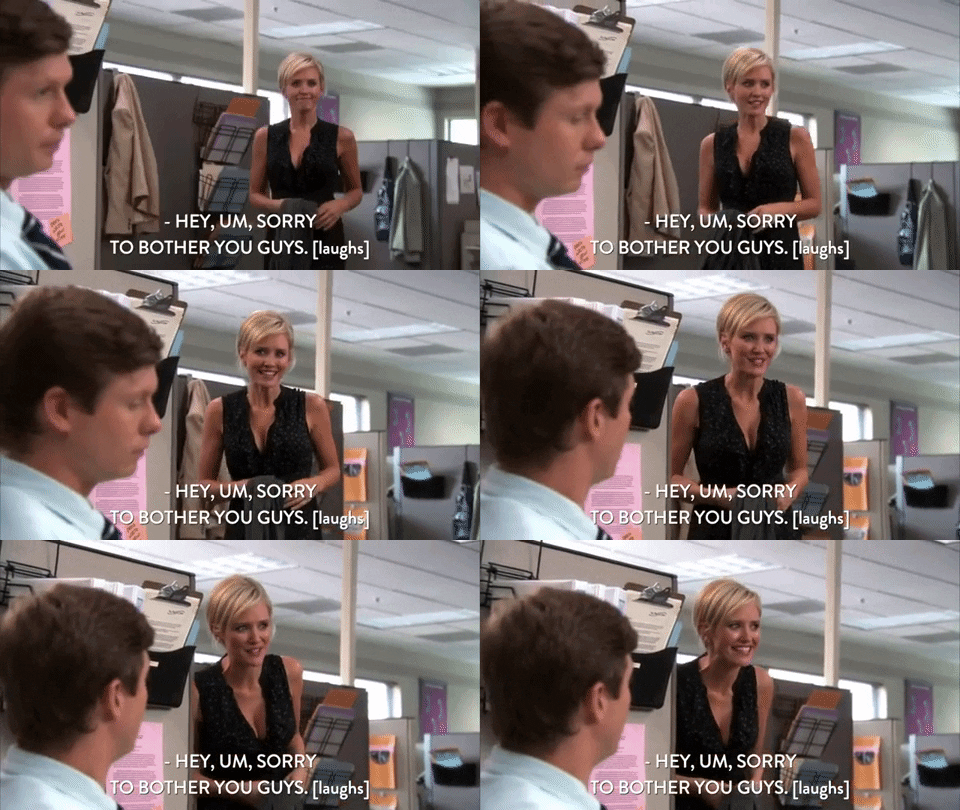
How do we do negative politeness strategies?
Brown and Levinson (1987) (the founding figures of negative and positive politeness strategies) kindly gave us a list of 10 negative politeness strategies:
- Be indirect
When you want something, you do not directly request what you want
It’s getting cold in here - Question, hedge
Here you would avoid saying directly what you want to say by using words like ‘quite’, ‘just’, ‘regular’, ‘sort of’, ‘pretty’
You’re quite right - Be pessimistic
This means you don’t assume straight away that the listener can fulfil the request
Could you do X? - Minimise the imposition
Using minimisers such as ‘just’ reduces the importance of the request
I just want to ask if I can borrow a tiny bit of paper? - Give deference
Giving deference means that you position the listener with respect
We look forward very much to dining with you - Apologise
Show that you feel bad or are reluctant about having to ask something
I hope this isn’t going to bother you too much… - Impersonalise the speaker and hearer
Avoid using personal pronouns like ‘you’ and ‘I’ to make the statement seem less personal
It looks like that… - State the FTA (face threatening act) as a general rule
By avoiding using pronouns, the speaker can express that something has to happen rather than them personally wanting it to happen
Passengers will you please refrain from flushing toilets on the train - Nominalise
Here you would use more nouns when speaking than verbs. The more nouns that are in a sentence means that the hearer is less likely to feel that they have to do or feel something
You performed well on the examinations and we were favourably impressed - Go on record as incurring a debt or as not indebting the hearer
You here express that you owe the listener something or they may owe you something
I’d be eternally grateful if you could…
(Brown and Levinson, 1987:132-210)
Are they universal?
Negative and positive politeness are typically mainstream British strategies to handling situations. Although Brown and Levinson (1982) state their politeness theory was universal, this is not agreed upon by everyone.
Not every culture will experience negative politeness strategies the same way.
Japanese culture experiences negative politeness strategies differently to how British English culture does (Matsumoto, 1988). Matsumoto’s (1988) study explored how Japanese speaker’s backchannel frequently in conversations. Backchannelling means to talk over another speaker in a conversation. This can affect the negative face of the speaker as it can be considered rude. As it is rude, in British Culture, right? The study states that backchanneling is used in Japanese culture to keep harmony in a conversation. As ideas “of individual freedom and autonomy may not be so emphasized in Japanese culture” (Brown, 2007:35). This shows us how negative politeness strategies can have different meanings in other cultures.
Japanese culture also adheres to negative face needs by creating social distance using honorific terms. For instance, the “honorific suffix -sensei (meaning ‘teacher’)” (Meyerhoff, 2015:85) is used by students along with their teachers’ surname. This is similar in German speaking cultures although differs from British English and Australian English cultures where University lecturers are addressed using their first names. What do you call your lecturers or teachers?
Another way negative politeness strategies differ between cultures is through being indirect. For instance, saying ‘it’s getting cold in here’ to hint at closing a window, is considered negative politeness strategy commonly used in British English culture although it is considered rude in Hebrew (Blum-Kulka, 1987).
It is important to have a cultural awareness when interacting with others. It can be said that if a culture commonly uses more negative politeness strategies such as British English and Japanese cultures then they can seem “aloof or cold if they move somewhere where positive politeness is emphasised more” (Meyerhoff, 2015:294). As with positive politeness strategies, it is good to have a cultural understanding in order to make conversations between cultures easier.
 Intercultural Politeness