The Past and Present of Politeness
Niamh Powell
Since before I can remember the words please and thank you have been an unconscious part of my vocabulary. Engrained in my vocabulary by my mother, but now the question arises in my head. How long has politeness been around for?
Politeness is an old and grey concept in most languages. The words themselves in different languages have specific historical connotations. In German for example the term Höflichkeit, refers to hof (‘court’) (Watts et al, 2019). In French the word poli is the past participle of polir ‘to polish’ (Watts, 2003).
In most historical counts of politeness, the court becomes the main reference as to where politeness develops. Even go so far as to say the court became a tool that of structured a social hierarchy in both France and Germany. Interesting right?
However, its history in English is slightly more complex. We don’t have any connotations which ties into the understanding of the word politeness.
Yet, the phenomenon of politeness is something that through the scientific study of language has become a widely known topic in the English history. Heavily within the history of scientific language study is the development of theories surrounding the phenomenon. Something which is still used today when discussing politeness. Here are some theories you need to know;
Theories of politeness you want to know about.
Robin Lakoff (1973)
“The mother of modern politeness theory”
Eelen (1999)
Lakoff kick-started the thought processes of looking at politeness, but it is important to know that his theory doesn’t give answers to all aspects of politeness. He states 3 important rules in his theory.
3 politeness rules
- Don’t impose
- Give options
- Make a feel good – be friendly
Brown and Levinson (1987)/ (1978)
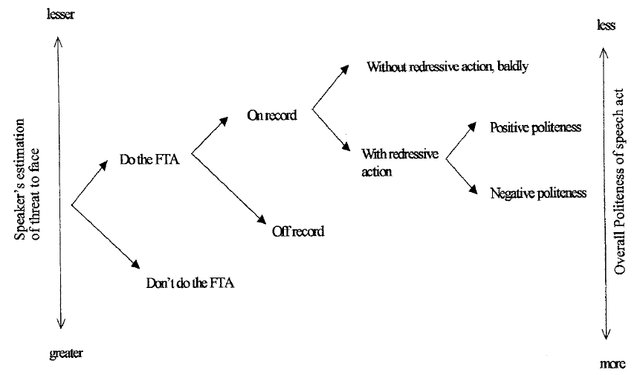
The whole bases of their theory rely upon FTA – face threatening acts. For more information on this read our blog post.
Brown and Levinson argue we have five major strategies into performing politeness. Here is their diagram;
Spencer-Oatey (2000b)
Develops her theory of politeness using some of the ideas surrounding face, but in the more general topic of rapport management. The two most important aspects of her theory centres upon the management of face and management of sociality rights. She puts a large amount of importance on sociality and face. Sociality can be described as what the social norms or tendencies individuals in communities have. Spencer-Oatey discusses in her theory the importance of this when performing politeness.
 Intercultural Politeness