Negotiating politeness in professional settings – as if working wasn’t already difficult enough

Negotiating politeness in professional settings – as if working wasn’t already difficult enough

Jana Sopf

As Schnurr & Zayts (2017) outline, the basic premise of language and workplace research is that when members from different cultural backgrounds interact, the differences in culture will inevitably result in misunderstanding or even conflict (p. 23). This claim is slightly problematic because it presupposes the emergence of conflict, or misunderstanding at the very least, in intercultural business interactions.

The basic principles related to intercultural (im)politeness – face and culture – are both dynamic and constantly evoked in intercultural interactions. As a result, there is no definite list of inherently impolite or face-threatening behaviours as they are negotiated between interlocutors as the interaction unfolds.

Zhu & Bao (2010) offer some advice for navigating the world of cross-cultural communication: “people should do their best to use the correct politeness principle [and] avoid the cultural conflict” (p. 851). However, this can prove slightly challenging; what happens when you have no knowledge of the ‘correct’ politeness principle?

E-mails:  a different dimension of politeness  

Although we can’t pinpoint exactly why, e-mails seem to be a universal pain for those in any intuitional setting, which is why many of us resort to a) procrastinating with replies or b) drafting hoards of passive-aggressive e-mails. However, since we are separated from our ‘interlocutor,’ it is actually not surprising that more effort is required to adapt our written dialogue to clearly reflect its illocutionary purpose (presuming that is the communicative goal). To anyone who has ever had to write a professional e-mail, this process of drafting and re-writing, procrastinating and contemplating whether you have accurately translated your tone of voice into an email is all too familiar. You might agonize over each word, your grammar, the amount of information you’ve included, whether you’ve gotten to the point and if you’ve hedged any face-threatening acts (e.g. requests, refusals) enough. Don’t forget your fair share of over-the-top pleasantries (e.g. ‘Thank you very much in advance!’) and deciding on the appropriate number of exclamation points to indicate that the text is not hostile! While we may all take too long mulling over our e-mails, it may indicate that we are struggling to transform and condense conversational politeness into one simple e-mail. Reading out loud can help getting a feel for how rude your e-mail sounds, or using tone-recognition software that can help your soften your language. However, if you are aiming for a passive aggressive tone, by all means – go for it!

“I live outside the UK so when I say ‘With all due respect’ nobody realises I’m insulting them”

Source: BuzzFeed British Problems

While being polite, or rather avoiding being rude, is always the clever choice, watch out for excessive apologies or timid language. Striking the right balance is tricky, especially since there are many ways to achieve an intended illocutionary force with linguistic forms. While it may seem a stereotypical British no-no, being direct and overt does not have to be inherently impolite. E-mail etiquette is slightly different from conventional interaction, cutting to the chase is a star quality to have because really – do we really want to sift through a web of eloquent grammatical constructions just to find the main idea?
Studies have shown that positive and negative politeness are equally frequent in the early stages of business contact, but negative politeness dominates in later stages (Pilegaard 1997). The theory behind this is that once common ground is established, there is less of a need to positive politeness as a “social accelerator” as the power dynamic becomes clearer (Pilegaard 1997, p. 241). Think of your correspondence with a professor – while the first e-mail typically opens with ‘Dear Professor X’ and end with a sincere closing such as ‘Best regards’, which heavily contrasts the typically less formal and rigid reply. Your professor might even not bother with a closing remark, resorting to a ‘sent from my iPhone’ instead of a ‘regards / cheerio / thanks’.
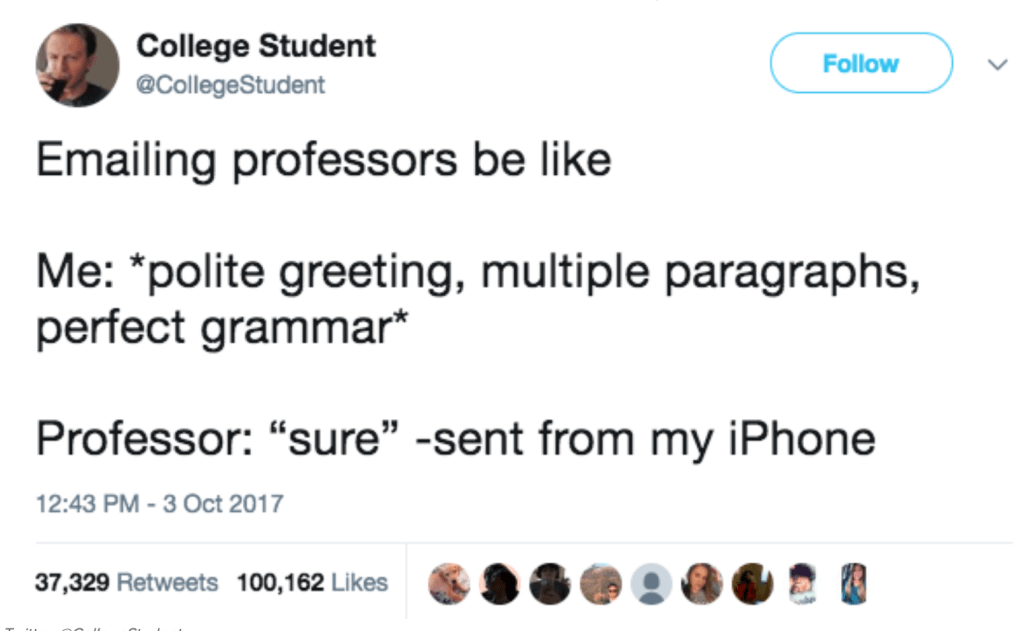

Image result for professor email meme sent from iphone"
Source: BuzzFeed


References

References

Al-Adaileh, B. A. M. (2007). The speech act of apology: a linguistic exploration of politeness orientation in British and Jordanian culture (Doctoral dissertation, University of Leeds).

Blum-Kulka, S. (1987). Indirectness and politeness in requests: Same or different?. Journal of Pragmatics, 11(2), 131-146. doi: 10.1016/0378-2166(87)90192-5.  

Bousfield, D., & Locher, M. A. (Eds.). (2008). Impoliteness in language: Studies on its interplay with power in theory and practice.  (Vol. 21). Walter de Gruyter.  

Brown, I. B. (2007). The applicability of Brown and Levinson’s theory of politeness to Japanese: a review of the English literature. 上越教育大学研究紀要26, 31-41.  

Brown, P. & Levinson, S.C. (1987). Politeness: Some Universals in Language Usage. Cambridge, UK: Cambridge University Press.  

Chang, W., & Haugh, M. (2011). Evaluation of im/politeness of an intercultural apology. Intercultural Pragmatics, 8, 411-442.  

Chen, R. 1993. Responding to compliments: A contrastive study of politeness strategies between American English and Chinese speakers. Journal of Pragmatics, 20, 49 – 75.  

Cheung, C. S. (2009). Politeness strategies of Chinese and American speakers. LCOM papers1, 45-54.  

Culpeper, J. (1996). Towards an anatomy of impoliteness. Journal of pragmatics, 25(3), 349-367.  

Culpeper, J. (2011). Impoliteness. The International Encyclopedia of Language and Social Interaction, 1-5.  

Eelen, G. (1999). Politeness and ideology: A critical review. Pragmatics, 9(1), 163-173.

 Goffman, E. (1955). On Face-Work: An analysis of ritual elements in social interaction, Psychiatry: Journal of Interpersonal Relations, 18:3, 213–231.  

Holmes, J. (2012) Politeness in intercultural discourse and communication. The handbook of intercultural discourse and communication. 205-229.

Lakoff, R. (1973). The logic of politeness: Or, minding your p’s and q’s. Papers from the 9th Regional Meeting of the Chicago Linguistic Society .292-305.   

Leech, G. (2014). The Pragmatics of Politeness. Oxford studies in sociolinguistics. Oxford, UK: Oxford University Press.

Lingley, D. (2017). Apologies Across Cultures: An Analysis of Intercultural Communication Problems Raised in the Ehime Maru Incident. The Asian EFL Journal, 8(1), 1-34.  

Matsumoto, Y. (1988). Reexamination of the universality of face: politeness phenomena in Japanese. Journal of Pragmatics 12, 403-426.   

Meyerhoff, M. (2015). Introducing sociolinguistics. London, UK: Routledge.  

Mills, S. (2017). Traditional approaches to language culture and politeness. In English Politeness and Class. (pp. 25-55). Cambridge: Cambridge University Press.  

Naotsuka, R. & Sakamoto, N., (1981). Mutual understanding of different cultures. Tokyo: Taishukan.  New York:  Oxford University Press.  

Olshtain, E., & Cohen, A. (1983). Apology: A speech act set. In N. Wolfson, & E. Judd (Eds.), Sociolinguistics and language acquisition (pp. 18-36). Rowley, MA: Newbury House.  

Pilegaard, M. (1997). Politeness in written business discourse: A textlinguistic perspective on requests. Journal of Pragmatics, 28(2), 223-244.  

Pragmatics association, 9:1, 163-173.  

Sari, M., K. (2016). Apology Strategy in English By Native Speaker. Lingua Cultura. 10(1), 13-17.  

Schnurr, S., & Zayts, O. (2017). Language and culture at work. Routledge.  

Spencer-Oatey, H. (1993) Conceptions of social relations and pragmatics research. Journal of pragmatics, 20:27-47.    

Spencer-Oatey, H. (2000a) Culturally speaking: Managing rapport through talk across cultures. London and New York: Continuum.    

Wang, V., X. (2019). Chinese workplace discourse: politeness strategies and power
dynamics 
In C., Shei (ed), The Routledge Handbook of Chinese Discourse Analysis (pp. 339-351). Abingdon, Oxon; New York, NY: Routledge.  

Wang, X. (2017). Productions and Perceptions of Apologies: Intercultural Comparisons. Asian Education Studies, 2(2),40-45.  

Watts, R. J. (2003) Politeness. Cambridge University Press.  

Watts, R., Ide, S., Ehlich, K. (2019). Politeness in Language. Studies in its History, Theory and Practice. Berlin, Boston: De Gruyter Mouton. Retrieved 19 Nov. 2019, from https://0-www-degruyter-com.pugwash.lib.warwick.ac.uk/view/product/12415  

Zhu, J., & Bao, Y. (2010). The Pragmatic Comparison of Chinese and Western ‘Politeness’ in Cross-cultural Communication.  Journal of Language Teaching & Research,  1(6).  

Glossary

Glossary

Photo by Pixabay on Pexels.com

Glossary

Theories of politeness

  • Social norm approach
  • Conversational contact approach
  • Conversational maxim approach
  • Leech’s politeness principles
  • Face-management approach (Brown & Levinson 1987)

Face 

Face-threatening acts (FTAs)

Face-saving acts

Watt’s theory of impoliteness (2003)

Positive politeness

Negative politeness 

Culpeper’s (1996) impoliteness superstrategies

Apology strategies